
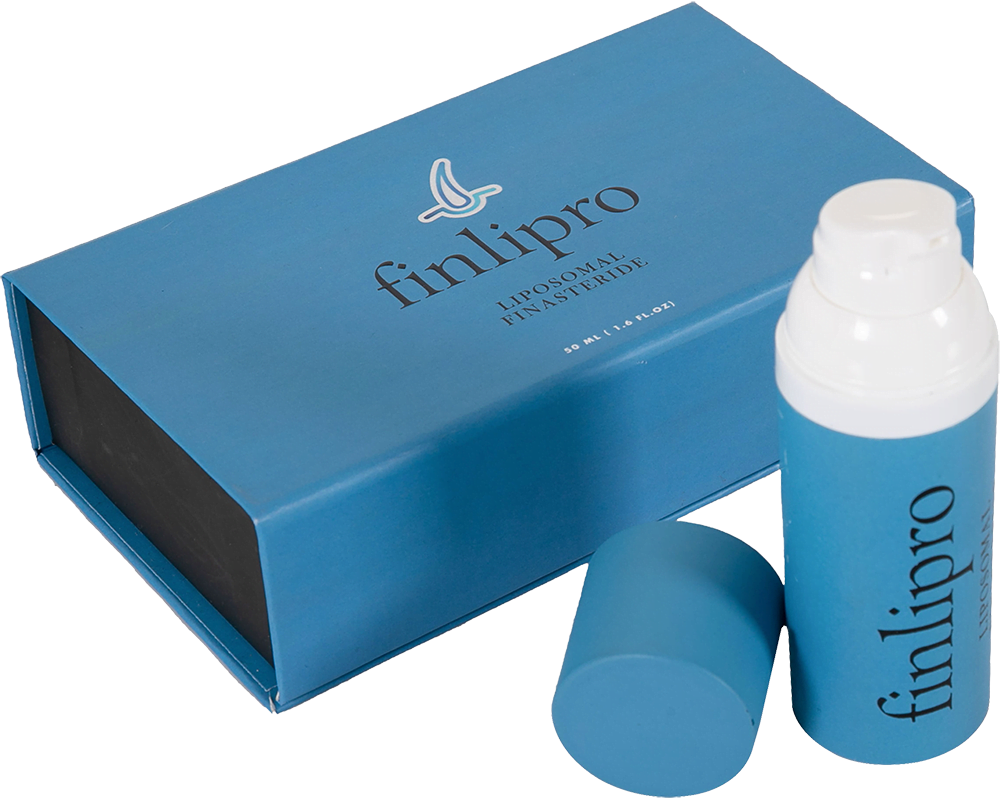
Liposomal finasteride represents an advanced topical approach to hair-loss management that combines finasteride with liposome-based delivery technology. The goal of this formulation is to improve the delivery of finasteride toward the scalp and hair follicles while potentially limiting unnecessary systemic exposure compared with oral treatment.

Liposomal finasteride combines the active ingredient finasteride with microscopic lipid-based carriers called liposomes. These carriers can encapsulate active ingredients and help transport them through the outer layers of the skin. In hair-loss formulations, researchers explore this technology because the hair follicle sits below the skin surface and effective topical delivery requires the active ingredient to reach the relevant follicular environment.
Finasteride belongs to a class of medicines known as 5-alpha-reductase inhibitors. It reduces the conversion of testosterone into dihydrotestosterone, or DHT, a hormone strongly associated with androgenetic alopecia in genetically susceptible individuals. By reducing DHT activity around susceptible follicles, finasteride can help slow follicular miniaturization and support the maintenance of existing hair.
The liposomal approach does not change finasteride’s fundamental pharmacological target. Instead, it focuses on how the active ingredient reaches the scalp and hair follicle. This distinction matters because formulation technology can influence penetration, distribution, stability and the amount of active ingredient that reaches a particular tissue.
Research into liposomal finasteride remains more limited than research into conventional oral or topical finasteride. A 2023 study investigated finasteride-loaded DMSO-modified liposomes and reported enhanced skin penetration characteristics in laboratory and animal models. However, these findings do not establish the same efficacy or safety profile in humans, so readers should distinguish experimental delivery research from clinically proven treatment.
A liposome consists primarily of lipid molecules arranged into a microscopic vesicle. Because its structure resembles certain components of biological membranes, researchers can use liposomes as carriers for pharmaceutical ingredients.
For topical hair-loss therapy, the concept involves placing finasteride inside or within a lipid-based delivery system and applying the formulation directly to the scalp. The carrier can interact with the skin’s surface and potentially facilitate movement of the active ingredient toward deeper layers where hair follicles reside.
The potential advantages include:
However, liposomal delivery does not automatically mean zero systemic absorption. Finasteride can cross the skin, and the actual systemic exposure depends on concentration, application area, vehicle composition, dose, frequency and individual skin characteristics.
This point separates responsible hair-loss information from marketing claims. A product should not claim that liposomal finasteride eliminates systemic effects simply because it uses a liposomal carrier.
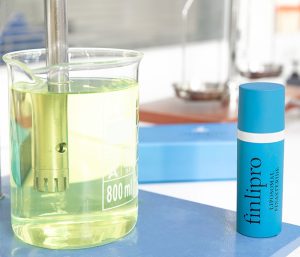
Androgenetic alopecia develops through a gradual process called follicular miniaturization. In susceptible individuals, affected follicles progressively produce thinner, shorter hairs. Over time, terminal hairs can become increasingly fine and less visible.
DHT plays an important role in this process. Finasteride targets the enzyme 5-alpha-reductase and consequently reduces DHT formation. This mechanism differs from treatments such as minoxidil, which primarily supports hair-growth activity through a different biological pathway.
For a topical formulation, the ideal scenario involves delivering sufficient finasteride to the scalp while minimizing unnecessary exposure elsewhere in the body. Researchers therefore continue to investigate specialized vehicles such as liposomes, nanoemulsions and other follicle-targeting systems.
A conventional topical finasteride formulation already has clinical evidence behind it. In a phase III randomized controlled study involving 458 men with androgenetic alopecia, topical finasteride produced a significantly greater improvement in target-area hair count than placebo after 24 weeks. The study also found substantially lower maximum plasma finasteride concentrations with topical treatment than with oral treatment.
The terms “topical finasteride” and “liposomal finasteride” should not automatically be treated as synonyms. Topical finasteride describes the route of administration, whereas liposomal finasteride describes a particular delivery technology.
A standard topical formulation can use solvents, gels, sprays or other vehicles to deliver finasteride across the scalp. A liposomal formulation adds a lipid-based carrier designed to influence how the active ingredient interacts with the skin.
| Feature | Oral Finasteride | Conventional Topical Finasteride | Liposomal Finasteride |
|---|---|---|---|
| Administration | Oral | Scalp application | Scalp application |
| Primary target | 5-alpha-reductase | 5-alpha-reductase | 5-alpha-reductase |
| Delivery approach | Systemic circulation | Direct scalp application | Liposome-assisted topical delivery |
| Follicular targeting | Indirect | More localized | Designed to enhance localized delivery |
| Systemic exposure | Higher | Potentially lower | May depend strongly on formulation |
| Clinical evidence | Extensive | Growing clinical evidence | More limited, especially in humans |
| Main research interest | Long-term efficacy | Localized treatment | Enhanced penetration and delivery |
The table highlights an important point: delivery technology and clinical evidence are two different questions. A sophisticated formulation can look promising from a pharmaceutical perspective while still requiring more human clinical research before researchers can confirm its long-term benefits.
The biggest theoretical advantage involves improving the delivery of finasteride to the scalp. Researchers want the active ingredient to reach the follicular structures efficiently without unnecessarily increasing exposure throughout the body.
A well-designed formulation may also improve the physical characteristics of a topical product. Depending on its composition, a liposomal system may influence how the active ingredient remains distributed within the formulation and how it interacts with the skin after application.
Potential benefits may include:
Still, these benefits remain formulation-dependent. Not every product marketed as “liposomal” provides the same delivery performance. Particle size, lipid composition, encapsulation efficiency, stability, concentration and manufacturing quality can all influence the final product.
The strongest human evidence currently concerns topical finasteride generally rather than liposomal finasteride specifically.
A phase III study published in the Journal of the European Academy of Dermatology and Venereology compared topical finasteride with placebo and oral finasteride in men with androgenetic alopecia. After 24 weeks, the topical group showed an adjusted mean increase of 20.2 hairs in the predefined target area compared with 6.7 hairs for placebo. Researchers also reported much lower maximum plasma finasteride concentrations with topical treatment than with oral finasteride.
Another phase III randomized study published in 2026 evaluated topical finasteride in 270 Chinese men with androgenetic alopecia. The researchers reported significantly greater target-area hair-count improvement at week 24 compared with placebo, alongside improvements in terminal hair measures and investigator-assessed vertex growth.
These findings strengthen the evidence base for topical finasteride, but they should not automatically transfer to every liposomal formulation. Different delivery systems can produce different pharmacokinetic and pharmacodynamic profiles.
Understanding DHT helps explain why finasteride attracts so much attention in hair-loss treatment. In androgenetic alopecia, genetically susceptible follicles can respond to androgen signaling with progressive miniaturization.
Finasteride inhibits type II 5-alpha-reductase, thereby reducing DHT production. The reduction occurs through enzyme inhibition rather than by physically blocking DHT from contacting the follicle.
Topical administration can still affect DHT beyond the immediate application site. A pharmacodynamic study of a 0.25% topical finasteride solution found substantial effects on scalp DHT and also measurable changes in serum DHT, demonstrating why topical treatment should not automatically receive a “no systemic absorption” label.
A separate review of topical finasteride research found evidence that topical formulations can reduce scalp and plasma DHT, while also highlighting differences between formulations and study designs.
Liposomal finasteride may attract interest from people who want a topical approach to androgenetic alopecia. However, the first step should involve determining whether androgenetic alopecia actually explains the hair loss.
Hair shedding can have many causes, including nutritional deficiencies, thyroid disorders, inflammatory scalp conditions, certain medications, acute illness and other dermatological problems. Finasteride specifically targets an androgen-related pathway, so it may not address the underlying cause when another condition produces the hair loss.
A dermatologist can evaluate:
For women, treatment decisions require particular care. The U.S. FDA labeling for oral finasteride specifically indicates Propecia for male pattern hair loss in men and lists pregnancy as a contraindication because of potential risk to a male fetus.
Do not judge a hair-loss treatment by the delivery technology alone. When evaluating a liposomal finasteride product, look beyond terms such as “advanced,” “nano,” or “targeted.”
Consider the actual formulation, concentration, application instructions, clinical evidence, regulatory status and manufacturing quality. A dermatologist or qualified healthcare professional can also help determine whether the formulation makes sense for your specific type of hair loss.
Consistency matters more than constantly changing products. Hair follicles operate through biological cycles, so meaningful changes generally require months rather than days.
A practical routine should focus on:
Taking standardized photographs can provide particularly useful information. Photograph the frontal hairline, temples and crown from the same angles and under similar lighting conditions every few months.
Finasteride remains a pharmacologically active medicine regardless of whether a formulation uses a liposomal carrier. Users should therefore approach topical formulations with the same seriousness they would apply to other prescription or medically supervised treatments.
Potential adverse effects depend on the specific formulation and individual response. Clinical studies of topical finasteride have generally reported favorable tolerability, but topical treatment can still produce local irritation or systemic exposure. Oral finasteride also carries recognized adverse-effect considerations, which is why medical supervision remains important.
Pregnant women should not handle crushed or broken finasteride tablets, and pregnancy-related precautions require particular attention with finasteride products. The appropriate precautions for a compounded topical product depend on its formulation and handling instructions, so users should follow the prescribing clinician and pharmacy’s guidance.
One common mistake involves expecting immediate regrowth. Hair follicles need time to move through growth cycles, and successful treatment generally requires sustained use.
Another mistake involves applying more product because someone believes a larger quantity will produce faster results. Increasing the dose without professional guidance can increase exposure without guaranteeing better hair growth.
Other frequent mistakes include:
A particularly important mistake involves confusing experimental research with established clinical evidence. Liposomal finasteride research has produced interesting formulation findings, but researchers still need robust human trials to determine how specific liposomal products compare with established topical and oral options.
Finasteride and minoxidil work through different mechanisms, which makes their combination an area of considerable interest in hair-loss treatment.
Clinical research has evaluated topical finasteride together with minoxidil. For example, a randomized study involving men with androgenetic alopecia found that a topical 0.25% finasteride plus 3% minoxidil solution produced greater improvements in hair density and diameter than 3% minoxidil alone after 24 weeks.
However, those findings apply to the studied formulation and population. They do not prove that every liposomal finasteride and minoxidil combination will provide the same outcome.
A clinician can determine whether combination therapy makes sense based on diagnosis, age, sex, treatment history, scalp condition and risk factors.
If someone considers a liposomal finasteride product, pharmaceutical quality deserves close attention. The term “liposomal” alone does not tell you how effectively the formulation delivers finasteride.
Important questions include:
These questions help separate evidence-based treatment from cosmetic marketing.
The development of advanced topical delivery systems reflects a broader trend in dermatological pharmacology. Researchers increasingly investigate ways to deliver active ingredients precisely where they need to work.
Liposomes represent one part of this larger field. Researchers also study nanoparticles, nanoemulsions, microneedle-assisted delivery and other technologies designed to improve follicular penetration.
The 2023 research on DMSO-modified finasteride liposomes illustrates this direction. Researchers reported enhanced skin penetration characteristics and evaluated the formulation in a testosterone-induced alopecia animal model. Such research provides useful formulation evidence, but animal results cannot replace well-controlled human trials.
Future studies could clarify whether liposomal formulations can consistently improve follicular delivery, reduce systemic exposure, improve tolerability or enhance treatment adherence compared with conventional topical finasteride.
Liposomal finasteride offers an interesting approach to topical hair-loss therapy by combining the established pharmacological action of finasteride with a specialized delivery system. The underlying goal involves directing more of the active ingredient toward the scalp and hair follicles while potentially limiting unnecessary systemic exposure.
Current human evidence supports topical finasteride as a promising treatment option for androgenetic alopecia, while direct clinical evidence for specific liposomal finasteride formulations remains comparatively limited. For that reason, patients should evaluate these products based on clinical evidence, formulation quality and professional guidance rather than relying solely on claims about advanced delivery.
Liposomal finasteride aims to deliver finasteride more efficiently to the scalp and hair follicles. Research on liposomal delivery remains more limited than the broader clinical evidence for topical finasteride, so effectiveness depends on the specific formulation and requires further human research.
Topical finasteride can produce lower systemic exposure than oral finasteride in some studied formulations, but it does not eliminate systemic absorption. The safety profile depends on the concentration, formulation, application method and individual response.
Hair growth develops gradually because follicles follow biological growth cycles. Clinical trials commonly evaluate treatment over several months, and users should avoid judging effectiveness after only a few weeks.
Finasteride and minoxidil target hair loss through different mechanisms, and clinical studies have investigated topical combinations. However, combining treatments should follow professional guidance, particularly when using compounded or specialized formulations.
